Global industry-leading manufacturer of high-performance, innovative solutions and components across a wide range of industries.
Serving Biopharm and Cell Therapy
Industry-leading provider of material science-based solutions in the biopharmaceutical and cell therapy markets for single-use fluid management.
Medical Components and Custom Solutions
We provide custom components and engineered systems for the medical device industry, including critical parts where precision enables superior performance.
Electronics and Semiconductor Industry Solutions
Design and manufacture a complete line of ultra-high purity, fluoropolymer-based fluid handling components and solutions for the electronics and semiconductor markets.
Industrial & Consumer Solutions (ICS)
Superior engineering and customer support to achieve safety, performance, and regulatory compliance across a broad range of capabilities. Offerings include Tygon® Tubing and Accessories, Hoses and Fittings, Heat Shrink Tubing, and High-Performance Seals.
Sensors Flow Measurement Solutions
Playing an essential role in preventing cross-contamination, validating essential processes, and driving cost savings, we specialize in the development and production of high-quality single-use flow sensors and corresponding equipment.
Furon Downstream Pressure Regulators: UPRM vs UPRP
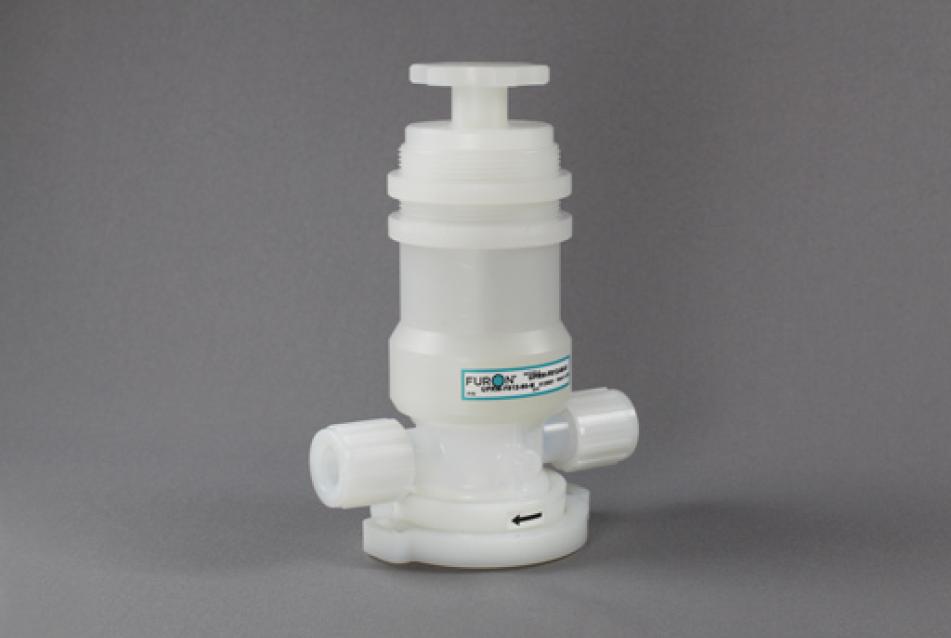
The Furon UPRM and UPRP Pressure Regulators are both specially designed to control and maintain downstream output flow pressures of liquid lines. This type of component is generally positioned upstream from sensitive equipment in order to prevent any alteration or damage to an operation caused by pressure fluctuations.
Manual vs Pneumatic
Pressure regulators can be controlled in two ways: Pneumatically or Manually
The Manual Version: Contains a spring which can adjust the load manually and is the element that drives the opening or closing of the diaphragm. Using a spring with a wide range will reduce the accuracy of its effect. Pro:
- Once your system is set it will not need to be adjusted
- No additional airline or air pressure regulator is needed Con:
- Needs to be set each time that you want to change the pressure value
- The window of operation can be limited by the spring
The Pneumatic Version: The air pressure that feeds the regulator is the element that drives the opening or closing of the diaphragm. The UPRP has a feature that provides a 1 to 1 ratio, which means the pressure that is used to feed the regulator should be equal to the pressure required as the controlled output value. Pro:
- Can be adjusted quickly based on the intake value Con:
- Need to settle an additional air line
How do they work?
The regulators oscillate continuously between an open and closed position, to control fluctuating liquid pressure.
Low Pressure in System
Set the pressure for control (Air actuation) greater than the spring force + outlet downstream force.
The shaft moves down, opening the sealing points, enabling the liquid to flow through.
High Pressure in System
As the liquid flows through, the outlet downstream force increases up to the point that the set pressure for control (Air actuation) is less than the spring force + outlet downstream force.
The shaft moves up, closing the sealing points, gradually reducing the liquid to flow through, reducing the outlet downstream force, allowing it to build up.
UPRM vs UPRP Pressure Regulators
The UPRP is an improved solution based on the UPRM design. The critical difference between the two regulators is the surface area of contact that controls the liquid pressure. See the Red diaphragm in the UPRM in Figure 1 vs the Green diaphragm on the UPRP in Figure 2. The greater the surface area of contact, the better response a system will have. This increases the pressure regulation range of coverage and has a more rapid and stable response. The greater the surface area of contact, the better response a system will have. This increases the pressure regulation range of coverage and has a more rapid and stable response.
An anti-shattering design on the UPRP (Blue Sealing Point) vs the standard sealing solution on the UPRM (Orange Sealing Point) enables a better response of the system, even at low flow.
#hero-banner-content-6366
#general-text-6346
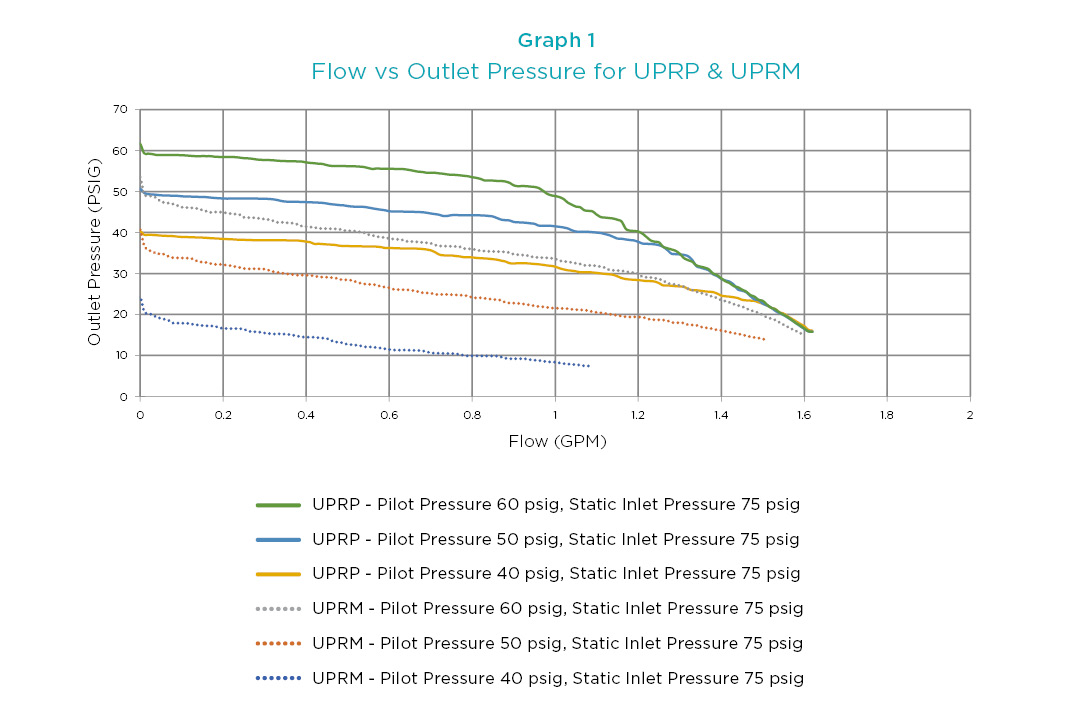
See the curves in Graph 1, the Flow vs Outlet Pressure for UPRP & UPRM: the long horizontal portion on the UPRP vs slightly steeper portion on the URPM.
Recommendation on Using One vs the Other
It all depends on the flow fluctuation of your system. The UPRP Precision Pressure Regulator is a more stable product for a high flow fluctuating system that provides a longer array of steady behavior, delivering a higher level of safety and piece of mind. The UPRM Pressure Regulator has a tighter window of operation which is optimal for a low flow fluctuating system that operates within its pressure regulation range.
The Furon UPRP is engineered to accurately maintain predetermined output pressures in fluid lines, available in manual and pneumatic actuator models. They are designed for precise delivery of aggressive pure chemicals and DI water applications that eliminate squealing and chatter at all flow rates.
#contact-us-1726
Contact us
Check on your order, invoice questions or other inquiry
Our expert engineers customize various products and configurations to suit your system needs
Request information on our Furon products and capabilities